
The Power Of VLAN Technology In Home WiFi Setups
The Power Of VLAN Technology In Home WiFi Setups
In Malaysia, fibre broadband users on Unifi, Maxis Fibre, and TIME are enjoying faster speeds than ever before. However, many households still struggle with inconsistent WiFi performance, buffering during peak hours, and network congestion caused by multiple devices competing for bandwidth. The root of this issue often lies in the limitations of ISP-provided all-in-one modem routers, which are not designed for advanced traffic management or modern home networking demands.
This is where VLAN technology becomes a powerful tool in transforming your home network into a smarter, faster, and more efficient system.
What Is VLAN and Why It Matters at Home
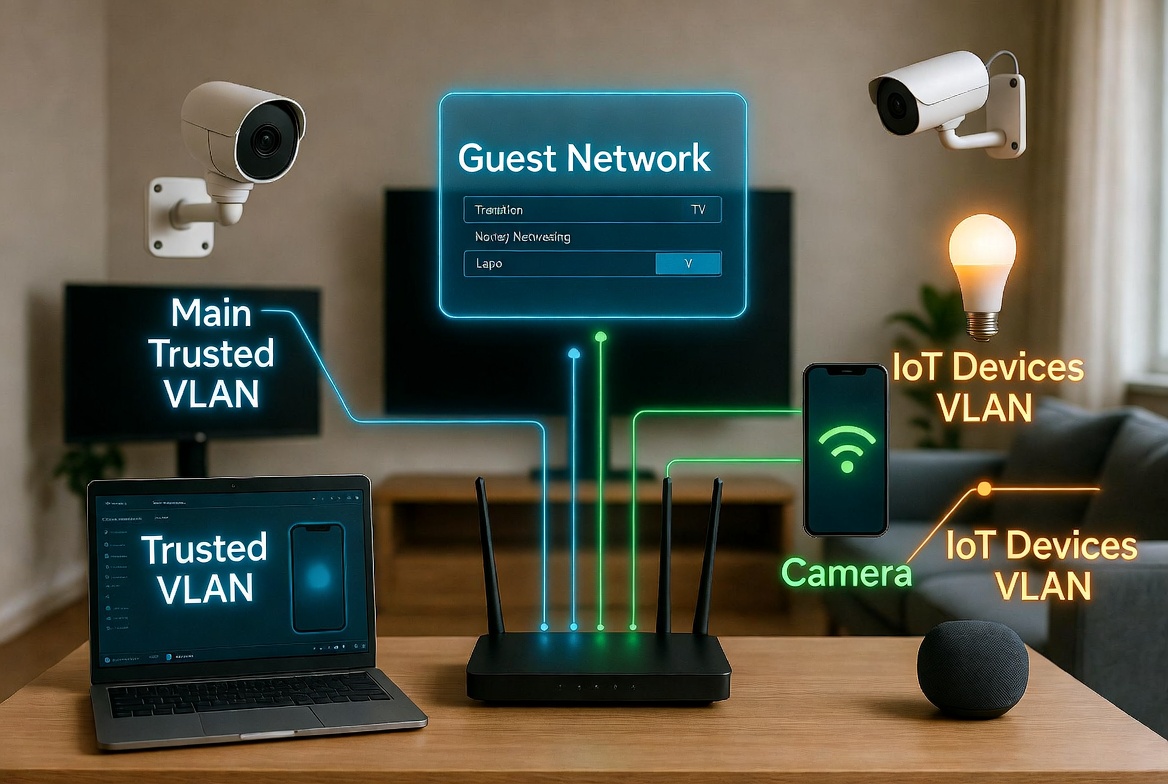
VLAN, or Virtual Local Area Network, allows you to logically segment your home network into multiple isolated networks, even when using the same physical infrastructure. Instead of every device competing equally for bandwidth, VLANs let you separate and prioritize traffic.
For example, you can isolate your work devices, gaming consoles, smart TVs, and IoT devices into different VLANs. This ensures that bandwidth-heavy activities like 4K streaming or large downloads do not interfere with video calls or online gaming. In a modern Malaysian household with dozens of connected devices, this level of control is no longer a luxury - it’s essential.
How TP-Link Access Points and Shield Wire Routers Enable VLAN
By combining a high-performance router like the Shield Wire Premium Router Model X-01 with a ceiling-mounted access point such as the TP-Link AX1800 Ceiling Mount WiFi 6 Access Point, users can unlock the full potential of VLAN tagging.
The router acts as the central brain of the network, handling VLAN creation, routing policies, and traffic prioritization. Meanwhile, the access point broadcasts multiple SSIDs, each mapped to a specific VLAN. For instance, you can create separate WiFi networks such as “Home”, “Work”, and “Guest”, each operating on its own VLAN with dedicated rules.
This setup ensures cleaner traffic flow and prevents unnecessary interference between devices, leading to smoother and more stable connectivity across your entire home.
Better Bandwidth Management and Network Stability
One of the biggest advantages of VLAN technology is precise bandwidth management. Instead of relying on basic QoS features found in ISP routers, VLANs allow you to enforce structured traffic separation.
In practical terms, this means your Zoom meetings won’t lag when someone else is streaming Netflix, and your gaming sessions remain stable even when multiple devices are online. By segmenting traffic at the network level, congestion is reduced and performance becomes far more predictable.
For Malaysian fibre users upgrading to 500Mbps, 1Gbps, or even 2Gbps plans, VLAN becomes increasingly important. Without proper segmentation, higher speeds alone cannot guarantee better performance.
The Advantage of Split Router and Access Point Design
A key factor in maximizing VLAN benefits is adopting a split router and access point architecture. Unlike ISP-provided all-in-one devices, which combine modem, router, and WiFi into a single unit, a split setup separates these functions for optimal performance.
The Shield Wire router focuses purely on routing, security, and DNS processing, while the TP-Link access point is dedicated to delivering strong, consistent WiFi coverage. This separation eliminates performance bottlenecks and allows each device to excel in its role.
When paired with VLAN technology, this design becomes significantly more powerful. Each VLAN can be mapped and managed centrally at the router level while being efficiently broadcast across the home through the access point. The result is a scalable and professional-grade home network that outperforms standard ISP setups.
Dual Private DNS: A Hidden Performance Booster
Another major advantage of the Shield Wire Premium Router Model X-01 is its built-in dual private DNS architecture. Unlike conventional routers that rely on external DNS services, this system uses two internal DNS resolvers for redundancy and speed.
This means faster domain resolution, reduced latency, and improved reliability. If one DNS server encounters issues, the secondary server seamlessly takes over, ensuring uninterrupted connectivity.
When combined with VLAN segmentation, DNS performance becomes even more efficient. Each VLAN can benefit from fast, cached DNS responses, reducing delays across different device groups and enhancing the overall user experience.
Ready for the Future with 2Gbps Networking
As Malaysia continues to push towards multi-gigabit fibre plans, having hardware that supports 2Gbps speeds is no longer optional. The Shield Wire Premium Router Model X-01 is designed with future-ready capabilities, ensuring your network can handle higher throughput without bottlenecks.
VLAN technology complements this by ensuring that increased bandwidth is distributed intelligently rather than wasted. Instead of a single congested network, you get multiple optimized channels of traffic working in harmony.
Why This Setup Outperforms ISP Routers
Standard ISP routers are built for simplicity and cost efficiency, not performance. They lack advanced VLAN capabilities, robust DNS systems, and the processing power needed for modern networking demands.
In contrast, a setup using a Shield Wire router and a TP-Link access point delivers enterprise-level features into a home environment. VLAN segmentation, dual private DNS, and dedicated hardware roles combine to create a network that is faster, more stable, and far more secure.
For Malaysian users who rely heavily on the internet for work, entertainment, and smart home devices, this upgrade represents a significant leap in performance and reliability.
Conclusion
VLAN technology is no longer just for businesses—it is a game changer for modern home WiFi setups in Malaysia. By pairing the Shield Wire Premium Router Model X-01 with the TP-Link AX1800 Ceiling Mount WiFi 6 Access Point, users can unlock superior bandwidth management, enhanced stability, and future-ready performance.
Combined with a split router and access point architecture, dual private DNS, and 2Gbps-ready hardware, this setup delivers a level of control and efficiency that ISP routers simply cannot match.
For anyone serious about maximizing their fibre broadband experience, VLAN is not just an upgrade—it is the foundation of a smarter home network.
#VLANMalaysia #WiFiOptimization #ShieldWire #TPLinkMalaysia #HomeNetworking #UnifiMalaysia #MaxisFibre #TIME
Share this article: