
In today’s distributed business environment, your network is no longer just a utility - it is the backbone of your customer experience and employee productivity. For Malaysian businesses expanding across the nation or Southeast Asia, the challenge isn't just connecting branches; it's connecting them intelligently.
At Shield Wire Solutions, we understand that traditional routing is buckling under the pressure of cloud applications, video conferencing, and real-time data sync. Based on current industry standards and common enterprise expectations, here is what a modern SD-WAN solution—like the ones we provide—must deliver to keep your multi-branch operation running at peak performance.
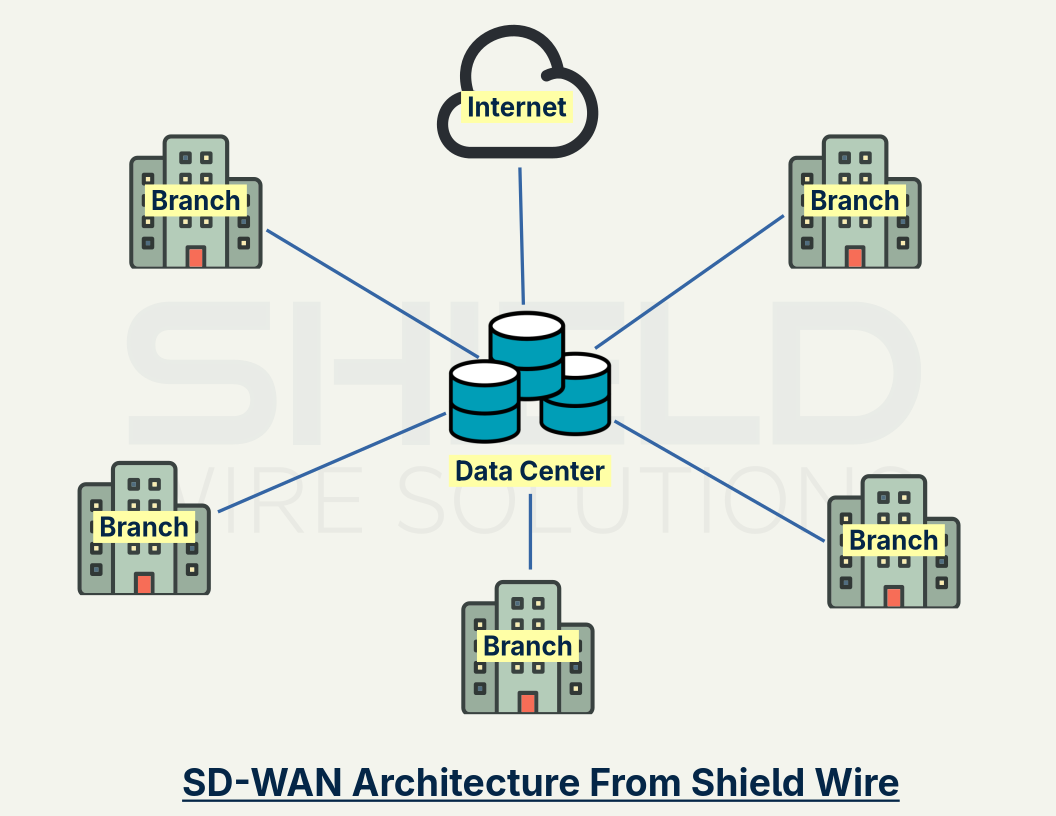
1. The Non-Negotiable: Low Latency & Application Performance
In a multi-branch setup, latency kills productivity. Whether it is a VoIP call between Penang and Johor or accessing a centralized ERP system, users expect instant responses.
Industry expectations for performance have shifted. A standard SD-WAN must support Application-Aware Routing. This means the network can distinguish between a critical financial transaction (which needs a stable, low-latency path) and a software update (which can take a cheaper route). Furthermore, solutions must offer Dynamic Path Selection, which measures packet loss, jitter, and latency in real-time, automatically shifting traffic to the healthiest link without dropping connections.
The Shield Wire Advantage: Our SD-WAN routers actively monitor link conditions to ensure that your branch traffic always travels via the lowest latency path, ensuring that your team never experiences the "trombone effect" of traffic being backhauled inefficiently.
2. VPN Solutions That Don't Bottleneck
Traditional VPNs backhaul all traffic from a branch to a central data center to inspect it. This kills speed. Multi-branch users expect direct, optimized access.
The modern expectation is Dynamic VPN Acceleration. This allows remote and branch users to bypass public internet bottlenecks while maintaining end-to-end encryption. Your SD-WAN should integrate VPN capabilities that allow for Direct Internet Access (DIA) , where local security policies are applied at the branch level, allowing cloud traffic (Office 365, Salesforce) to egress locally rather than traveling all the way back to HQ.
The Shield Wire Advantage: We deploy "thin-edge" architectures where VPN tunnels are intelligent. They establish secure, high-speed connections between branches instantly, without the need for complex manual firewall backhaul rules.
3. Built-in Private DNS Servers
Security often focuses on IP traffic, but DNS remains a vulnerability. Multi-branch enterprises now expect DNS-level security as a core feature, not an add-on.
Modern SD-WAN solutions are integrating Private DNS filtering directly into the network fabric. This allows administrators to block malicious sites, control content, and resolve internal hostnames securely without exposing DNS queries to the public internet. By routing DNS traffic to a private resolver, you preserve source internal IP visibility—meaning you know exactly which user in which branch tried to access a threat.
The Shield Wire Insight: By utilising built-in private DNS servers, you add a layer of zero-trust security that stops malware from communicating with command centers, all while improving lookup speeds for internal applications.
4. Zero-Touch Deployment & Centralized Control
You cannot fly a technician to a remote retail outlet or pop-up branch every time a router needs configuration. The industry expects Zero-Touch Provisioning (ZTP).
A non-technical staff member should be able to plug the Shield Wire router into power and a broadband line, and the device should automatically "phone home," download its configuration, and apply the correct security policies for that specific branch.
The Shield Wire Advantage: Our orchestration platform gives you a single pane of glass to manage QoS, security, and VPN policies across 10 or 100 branches. Changes are made once and pushed globally.
5. Hybrid WAN & Link Remediation
You cannot rely solely on MPLS (expensive) or broadband (unpredictable). The standard is Hybrid WAN support.
Enterprises expect SD-WAN to bond multiple links—5G/LTE, Fiber, and Broadband—into a single, resilient fabric. If a fiber line experiences jitter, the SD-WAN router must perform Remediation (forward error correction or packet duplication) to maintain voice quality, or seamlessly fail over to LTE without dropping the session.
Why Shield Wire?
At Shield Wire, we don't just sell hardware; we deliver reliability. Our SD-WAN solutions are engineered for the unique demands of the Malaysian market—from the bustling hubs of Penang to the industrial zones of Johor.
We provide the built-in private DNS to keep you compliant and secure, the VPN optimization to keep your data flowing, and the low latency routing to keep your business competitive.
Ready to unify your branches?
Visit Shield Wire Solutions today to discuss how our custom SD-WAN solutions can replace your legacy routers and bring your distributed network into the future.